


A team can have a beautiful strategy deck, a clean set of OKRs, and a well-groomed backlog, and still not know whether today’s work has a believable path to the outcome they care about.
On the surface, everything looks connected. The company objective points to a strategy. The strategy points to initiatives. The initiatives become epics. The epics break into stories. The hierarchy is visible enough that everyone can nod along.
But the visible cascade is only the tip.
Underneath it is the real structure: a hidden chain of assumptions, like users will behave differently, this metric represents real value, this data is trustworthy, this dependency will unblock in time, the market will still care about this and the customer problem is still the same problem we thought it was.
Those assumptions are beliefs that actually connect strategy to work. The documents at the top of your cascade just make the connection look clear.
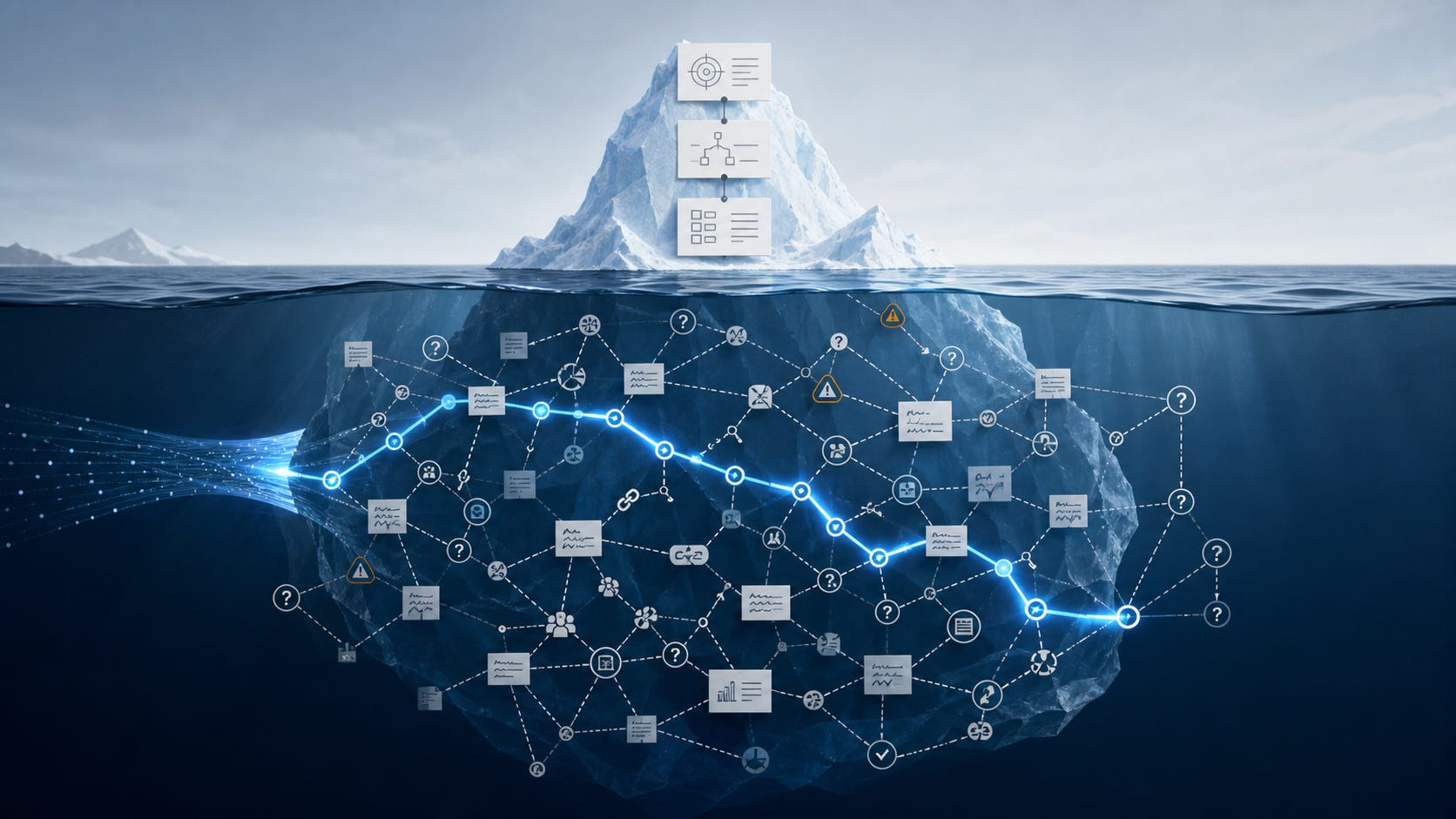
Most Don’t See the Chain
A goal cascade is usually presented as a hierarchy of intent. Company goal at the top. Product outcomes underneath. Initiatives below that. Work items at the bottom.
That structure is useful, but it hides the part that matters most. The path from one layer to the next depends on claims that aren’t usually explicit. They’re more likely to come from single-serving Slack threads, meeting notes, backlog bugs, or someone’s memory of why a decision was made three months ago.
That is why teams can be “aligned” and still be wrong. They are aligned around the visible structure, while the hidden assumption chain remains untested.
Take a simple outcome statement you might see at the top of a cascade. No matter how reasonable and rational it sounds, it contains a chain of beliefs that need to influence not only how you measure success of the outcome but also how you approach it.
As an example, imagine the goal “Improve onboarding to increase retention”
let’s say one key assumption that led to the work getting prioritized is that early dropoffs are caused by friction in the existing onboarding flow. That assumption detail does not always belong at the top of the cascade, but it’s critical for the team to validate as part of their approach. If the team isn’t all aware of that assumption and someone else comes in without awareness, the team could waste a lot of time building a new onboarding feature that completely misses the reason to do this in the first place.
And assumptions go layers deep, with assumptions build on assumptions on assumptions. We assume the onboarding behavior being targeted predicts long-term value, that retained users are actually successful users, and that we can change the experience without creating new confusion somewhere else.
In reality, the chain of assumptions under every goal is probably more spider web than cascade. If the links hold, the work has a path to impact. If one or two links are weak, the team may still ship useful improvements, but the strategic story starts to wobble.
AI Makes Weak Chains Spread Faster
Writing the cascade and connecting the dots is slow, confusing, thankless work. There’s a reason most cascades stop 2-3 layers in: the connective tissue between layers gets less and less clear and the effort to make it coherent feels like diminishing returns. Still, the exercise itself forced some thought that makes product teams make choices.
AI can change this. Given the right context and constraints it can generate an entire comprehensive goal cascade replete with strategies, justifications, initiative ideas, and annotated research, and get it all approved faster than a team can inspect the assumptions underneath them. For teams that already understands the chain this is a modern day miracle.
It’s still dangerous when generation becomes a substitute for understanding though. The risk is that AI can help weak cascades look coherent sooner. The work gains the appearance of alignment without any deliberate thought.
AI Is Better at Seeing Across the Mess
This is also why AI is useful here.
Humans are good at judgment, context, and sensing when something feels off. But we are bad at holding a messy web of documents, conversations, research, metrics, dependencies, and decisions in our heads at the same time.
AI is unusually good at traversing that mess. It can compare the roadmap to customer interviews. It can look for whether a metric has ever been defined clearly. It can notice that three initiatives depend on the same unvalidated belief. It can connect a support theme to a product bet, or a decision log to a dependency nobody has mentioned in the current planning cycle.
That does not mean AI knows whether the strategy is right. It means AI can help surface the hidden links humans are likely to miss and articulate the significance as signal vs noise.
The better prompt is not “write our goal cascade.” Instead, try asking AI to inspect the chain:
“Given this goal, strategy, research, metrics, and backlog, identify the assumptions that must be true for this work to create the intended outcome. For each assumption, show the evidence, contradictions, dependencies, risks, and what we still need to learn.”
The Hidden Chain Should Be Inspectable
A useful AI-assisted cascade would not only show parent and child items. It would show the assumption chain that gives the cascade meaning.
[assumption doc template title]
Objective: reduce churn in the first 90 days.
Hidden assumption: customers who fail to invite teammates in week one are less likely to renew.
Evidence: cohort analysis from the last two quarters, plus cancellation interviews.
Risk: the invite event may be a proxy for company size, not onboarding quality.
Dependency: analytics must distinguish invited users from activated collaborators.
Learning needed: test whether prompted invitations increase retained collaborative use, not just invitation clicks.
That changes the conversation. The team is no longer debating whether the initiative sounds aligned. They are asking whether the chain is strong enough to carry the bet.
That is where AI can help. It can illuminate the submerged structure. It can show where a link is supported by evidence, where it depends on an old decision, where two teams are relying on incompatible assumptions, or where the chain simply disappears.
The Point Is Not More Planning Artifacts
There is a reasonable objection here. Teams do not need new assumptions templates and more documentation. Many already drown in planning rituals, templates, and status artifacts.
The point is not to create an assumption bureaucracy. The point is to make the load-bearing assumptions visible at the moment they shape decisions. With AI teams don’t need to document every possible belief and they can more easily see which hidden links must hold for the work to matter.
The practical test is simple: for any important goal, initiative, or backlog theme, ask what must be true for this to create the outcome we expect?
If the answer is obvious and supported, keep moving. If the answer is vague, contested, or unclear, that is a place where AI can help. Ask it to trace evidence, to find contradictions, or to map dependencies. Use it to understand which initiatives rely on the same assumption. Ask it to separate what the team knows from what the team hopes.
Artifacts Get Cheaper. Belief Gets Harder.
When AI makes artifacts cheaper, the harder work becomes deciding what deserves belief.
A polished strategy, long backlog, or clean OKR tree mean less by themselves. Their value depends on the hidden chain underneath them: the assumptions, evidence, dependencies, and risks that explain why the work should produce the outcome.
I think this will make goal cascades more demanding, not less. A cascade should help a team move from purpose to action without forgetting the uncertainty along the way. When artifacts all communicate with certainty, the uncertainty doesn’t disappear from the actual work. It waits until later, when it is more expensive to face.
AI can help teams use the submerged structure. It can trace connections across messy information that humans do not have time to hold all at once. It can illuminate the hidden chain between goals and work.
Humans are good at judgment, but bad at holding the whole web in our heads. AI can help trace that web across the messy material of work. The opportunity is not faster goal generation. It is making the invisible assumption chain visible enough to challenge.