A charm on the backpack
At Meta Connect, Mark Zuckerberg held up something that looked less like a new computer and more like a toy a kid might clip to a backpack. Kind of like something out of Ron’s Gone Wrong.
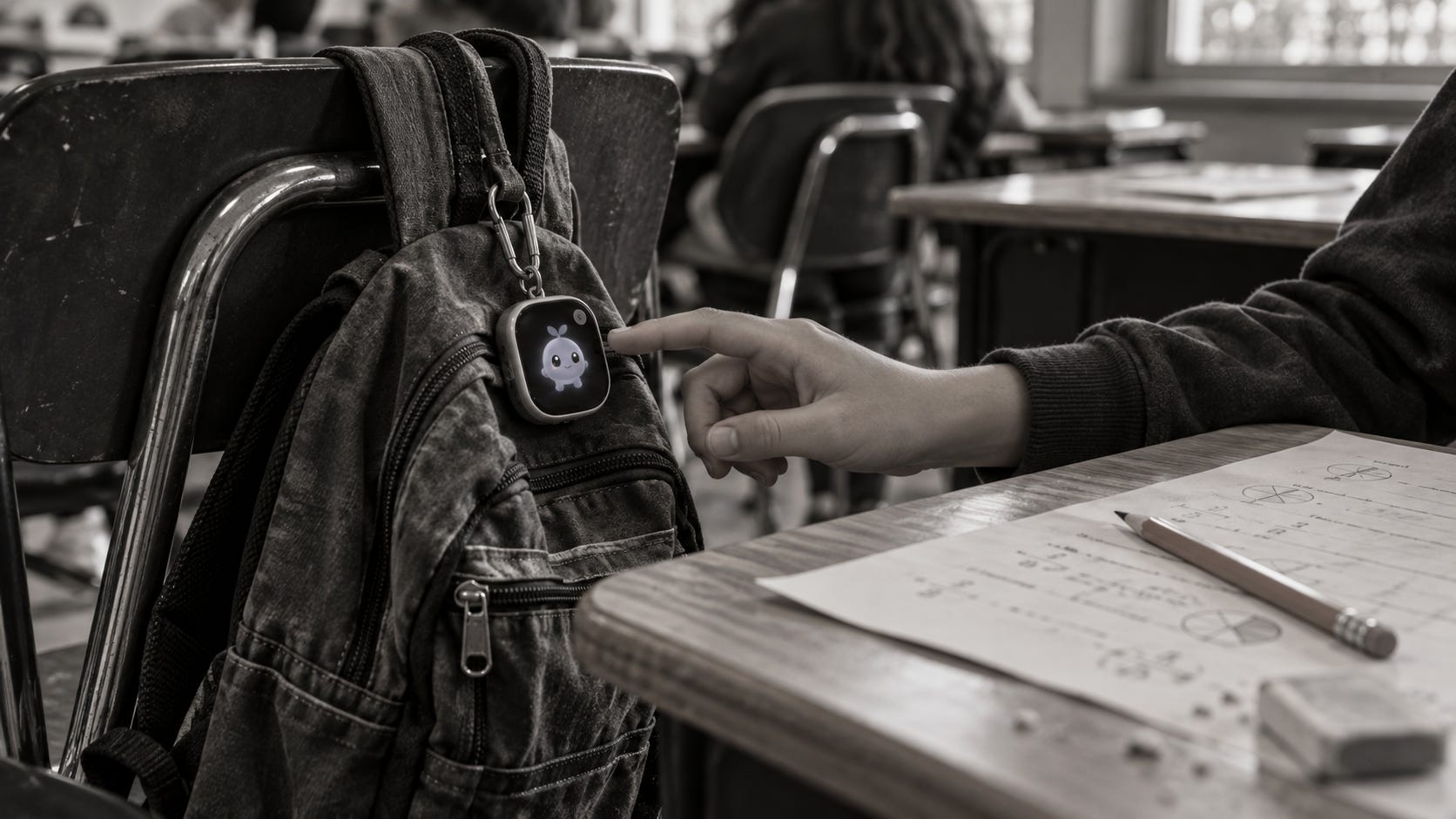
The Muse Charm is a palm-sized device with a small screen, a digital avatar, real-time voice, and a fingerprint sensor. Tap the corner and you can start talking without unlocking a phone or opening an app. Meta called it a “delightful and fun” way to keep its Muse agent in your pocket. Early coverage reached for the obvious comparison: Tamagotchi.
The comparison works visually. The Charm is small, rounded, expressive, and designed to hang from something you already carry. It also fits a broader trend of turning technology into a personal accessory, from bag charms to old Apple Watches repurposed as keychains.
But a Tamagotchi was never just a tiny screen. It trained a behavior. I remember classmates checking theirs between classes and pulling them out when they asked for attention. Caring for the device became a small loop in the day.
The Charm trains a different behavior. You have a thought, tap the device, and start talking. It can respond with an answer or carry out a task. Meta described it as the fastest way to talk to Muse when you are not wearing its glasses. AI is available wherever and whenever you need something answered.
Meta did not present the Charm as a children’s device. Still, that future is easy to picture. A kid clips one to a backpack, gives the avatar a name, and carries it between home and school. When they feel uncertain or curious the Charm is right there.
So what happens when AI becomes the first place kids turn? Not just for facts, but for help understanding what happened, what to say, and what to do next.
My parents were right about the wrong skill
A world where AI is the first place children turn feels alien to me. But every generation has some version of this anxiety. We see a new tool and worry that the next generation will lose something we had to learn.
I remember my parents doing this when I wrote research papers in school. I wanted to use the CD-ROM version of Encyclopedia Britannica. Their answer was clear: “You can look up one thing, but then you have to use the real encyclopedias for the rest. Reading an encyclopedia is a skill that will never go out of style.”
They could not imagine that navigating alphabetized volumes would stop being useful. And of course it did. Google, Wikipedia, and the rest of the internet gave us a much faster route to information.
But the need to investigate did not disappear. I still had to decide which question to ask, what information mattered, and when to keep going down the rabbit hole. My parents were right that I needed to learn how to figure things out. They were wrong about which tool would teach me.
That memory keeps me from assuming kids are learning less simply because they ask an AI companion for help. They may just be using the tool that fits their world.
The difference is that my tool changed the route to an answer. An AI companion can take over parts of the thinking along the way.
What skills will the future need to learn?
So I keep coming back to a different question: If AI is going to be everywhere in children’s lives, do they need to learn the same skills in the same way we did? Which abilities will still matter, which ones will change, and what kind of practice will the next generation need?
The encyclopedia and the internet mostly changed how I reached information. I still had to decide what I was looking for, make sense of what I found, and choose what to do with it. An AI companion can step into more of that process.
Imagine a kid wondering whether to apologize after an argument with a friend. A companion that knows the history could interpret what happened and then suggest exactly what to say. That goes beyond finding information. It feels more like guidance from a fried or mentor.
There is real value in a companion that can act like a coach that is available at the moment help is needed. But a companion that keeps deciding what the situation means and what to do next means kids get less practice working through things themselves. They do not have to sit with uncertainty, consider what might happen, or decide what they believe. The easiest path is to ask.
And if asking AI becomes the habit, we have to get more precise about what kids are actually learning.
Separate the skill from the way we learned it
Part of the problem is that we bundle three things together: how we practiced, the ability that practice developed, and what we could eventually do because of it.
Using a printed encyclopedia was a method. Investigating an unfamiliar subject was the ability. The result was that I could enter a topic I didn’t understand and come away knowing more than when I started. My parents focused on the method because it was easy to see. The ability underneath it was harder to name.
If kids no longer have to experience problem solving in the way past generations did, are they losing that ability? Or are they learning a different set of abilities for a world where AI is part of almost everything?
When I think back to those research papers, the CD-ROM made it easier to find information but it didn’t do the assignment for me. I still had to build the argument and write the paper.
Kids with an AI companion may not have to do any of that. If one question gives them something decent, why take the longer route? The easiest choice is to let AI do the whole thing.
We can say they should review the AI’s work and question weak claims. But why would they learn to do that if the assignment only rewards the finished paper? Reviewing becomes extra work with no clear payoff. We give them a tool that makes the task easier, then ask them to choose the harder path anyway.
They will learn differently from what I learned by writing papers. Some writing skills will still matter. Others may matter less, or we may need to teach them another way.
Once AI can produce a good enough answer in seconds, the real work of learning has to happen somewhere else.
What should kids still have to do?
The next generation don’t need every obstacle we faced. Adults tend to give too much credit to familiar friction. We remember that something was hard and assume the difficulty must have taught us something.
I used a TI-83 calculator in school, a tool my parents never had, but I still learned how to do the math. Growing up I used paper maps (or later, MapQuest), and now I can spend much less attention on the route since I can use Google Maps or Waze.
What I’m curious about is what AI-on-the-shoulder kids still have to do differently, and what’s the impact.
Imagine a kid has an argument with a friend and vents to their AI Charm.
One possibility is the companion takes the story, makes as assessment of what happened and what to do next, and writes a polished apology to say the friend. They might then follow the AI’s guidance without having decided whether they are actually sorry or how they feel about it. They acted on the AI’s advice to solve the immediate problem without working through the uncomfortable experience themselves.
Another possibility asks before answering: What happened? What do you think upset your friend? What do you wish you had done differently? What do you want them to understand? The companion can still help with the apology. But the kid has to form a view before the AI turns it into words. Both versions could produce the same result, but the experience is very different.
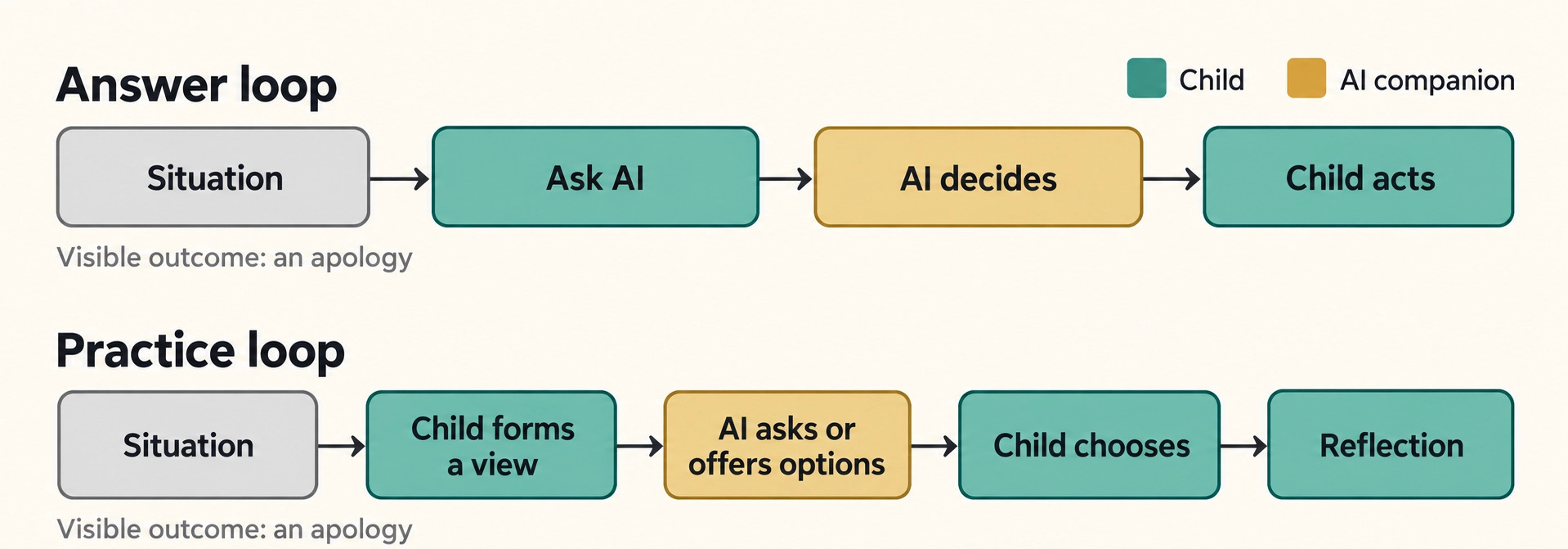
Will we expect the product to decide what route to take? Younger kids may need more direct help. A serious or unsafe situation should bring in an adult. It could ask kids what they think before offering a view. It could show options and possible consequences without choosing for them. It could say what it’s not sure about.
I think the goal should be to keep kids involved in the part that helps them learn.
The skill underneath the tool
The next generation may define independence differently than we do. Kids may use AI constantly and still learn to think for themselves. How often they reach for the tool will tell us less than what they can do after they use it habitually.
Can they form a view before asking for one? Can they explain why an idea or option makes sense? Can they sense when the device is wrong and act even when it’s not there?
Those questions bring me back to the encyclopedias.
My parents were wrong that reading a printed encyclopedia would always matter. They were right that I needed to learn how to figure things out.
They could not predict the tools I would use as an adult. We cannot predict exactly how kids will use AI either. The methods will change. Some abilities may change with them. Others may become more important because an answer is always close by.
An AI companion will teach something through the way it responds, even if that lesson was never written into the product. It might help kids ask better questions, consider another point of view, or explain what they believe. It might also teach them to hand over the moment before they have tried.
The most important thing is to set the next generation up to succeed without stunting their ability to learn, even if their world looks nothing like the one we knew.