


A couple months ago I heard someone describe two ways of moving through the world: surfing and diving. The metaphor is sticking with me because it gives language to a difference I keep feeling when I use AI.
Surfing is broad. When you find the current, rides the waves, and if you catch the ride motion it feels smooth. You can cover a lot of water and watch the horizon. There’s a satisfying sensation of moving quickly with very little resistance.
There is a seductive confidence to surfing. From above, you see a vast amount of ocean al the way to the horizon and it’s easy to orient yourself relative to surroundings. But the downside is the surface gives you a particular kind of knowledge that, while wide, fast, and useful, is also thin. You go where you are carried, always somewhat at the mercy of the wave and at risk of being knocked off.
In contrast, diving begins when you go below the waves, fully immersed in that world. You are exploring inside the thing itself. Good diving is controlled exploration. It requires focus, curiosity, and determination to keep going deeper.
That distinction came back to me this week because of this post, wondering whether six months of using Claude Code had made him less sharp.
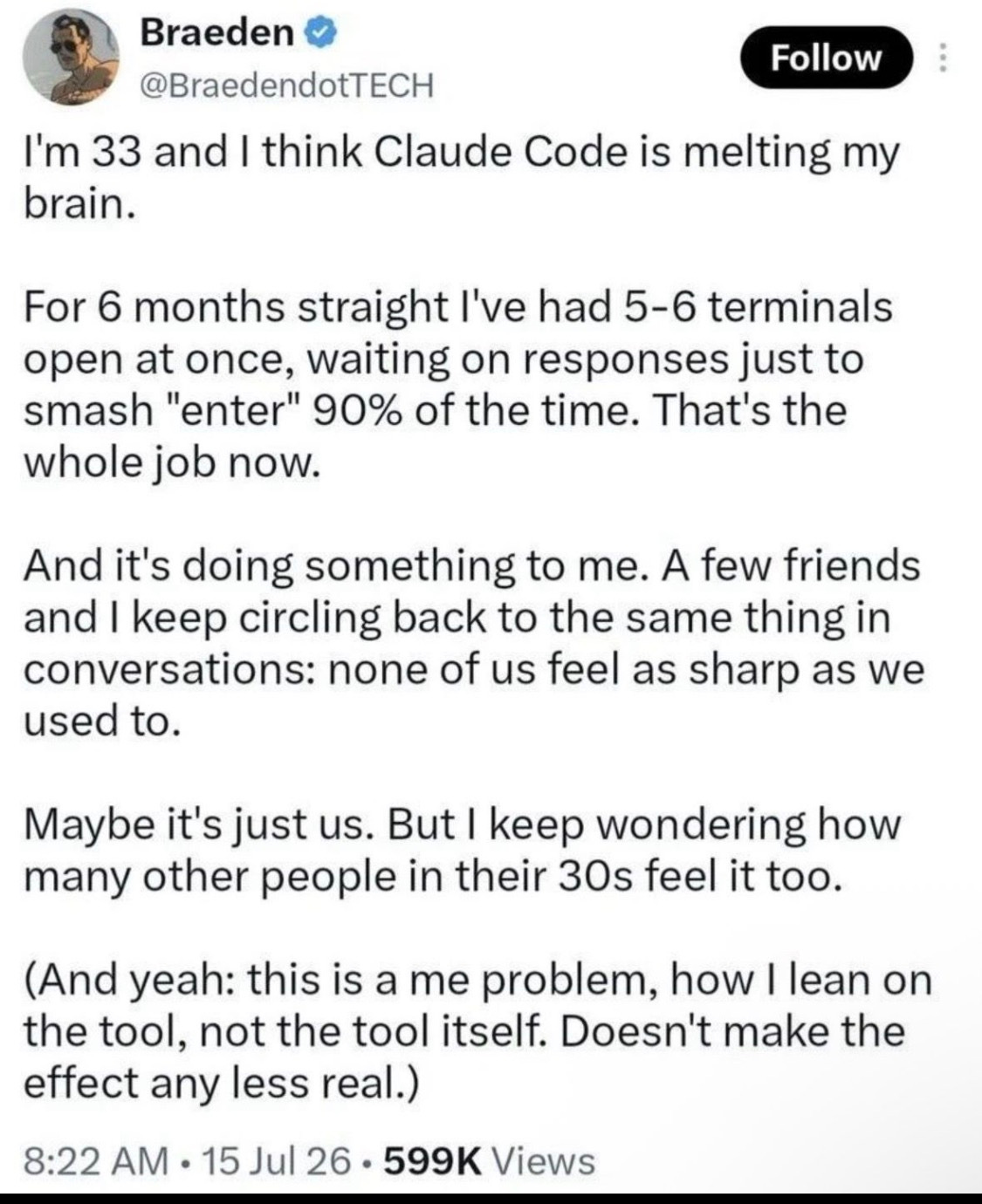
I recognize this feeling, but I’m not convinced AI is making us less sharp. I think what’s more likely happening is AI is training us to surf when we used to dive.
Using AI is like surfing. If you’ve used an LLM as a thought partner then you’ve experienced how incredibly easy it makes it to grasp almost any subject at surface level. It’ss a Will Hunting experience of curiosity: suddenly there is a brilliant person in the room who can make almost anything feel legible.
There are plenty of questions where surfing is enough:
Why does this work that way?
What are people disagreeing about?
What vocabulary do I need before I can follow the conversation?
What is another perspective that would help me orient?
I want AI for these questions. On the other hand there are other questions that should ask more of us:
What do I believe?
What am I assuming?
What would I believe if the conventional explanation turned out to be wrong?
Why does this matter to my context?
These are diving questions. More than requests for information, they are invitations to let an idea push back on you until your own conviction changes.
If my beliefs started to be formed mostly by what I could see from the surface, I think it would feel a lot like becoming less sharp, even if it was hard to spot at the time: more immediate fluency with less experience. To keep that sharpness you want some ideas to push back on you.
Surfing runs on compression
As I’ve written about before in the context of fast and slow thinking, AI often gives us the appearance of deep thought without requiring us to do the deep thinking ourselves.
Surfing ideas with AI runs on compression, letting us move quickly through complexity. We begin to understand things through using stereotypes, conventional wisdom, pattern recognition, analogies, and three-noun Oxford-comma descriptions of things to get our bearings. (Yes, I used an Oxford comma. My mom was an English professor. You won’t convince me it’s not the best way to write.)
The problem with too much information surfing is that compression, by it’s definition, strips out nuanced details, history, and texture without providing notions of lived experience that depth turns into understanding. AI provides you with an average the averages and make them readable. It will give you the clean version of anything.
Granted, sometimes the clean version is exactly what you need. Like if I’m trying to learn the current debate around a certain programming language or about a historical moment or scientific concept, for example, then I am grateful for the surfing because I only need a surface level understanding to move forward.
The old cost of curiosity was time, chasing down badly organized material and trying to sense-make while also figuring out the path of exploration to take. Surfing doesn’t come with a lot of that friction anymore, but the mistake I see is not realizing we are compressing away not only waste, but reflection and confusion that was crucial to deeper understanding in the first place.
You ask. It answers. You nod. The idea feels handled. The ability to go deep requires time commitment and the curiosity to stay under the water exploring.
Fluency can feel a lot like understanding, but it isn’t
Sometimes I wonder why. Why dive anymore? If I can become conversationally fluent in something completely foreign in minutes, why choose the slower path? Why read the source material? Why struggle through the argument myself? I think to myself, maybe the future belongs to people who can skim intelligently, synthesize quickly, and move on.
I half-believe that. Maybe diving is sometimes a romantic attachment to inefficiency. But then I think about the parts of thinking that are not about legibility.
There is a deeply human satisfaction that Braeden’s tweet reminds me of in diving down a rabbit hole of question to answer to more questions and paths. That process is tedious and time-consuming yet so central to human nature and the pursuit of knowledge. And that winding path is usually where deep understanding sparks.
The problem gets more serious when fluency influences authority to act. Knowing the vocabulary of a domain can make someone feel qualified to overrule the people who have spent years learning its exceptions. There are plenty of examples of decision makers with surface level experience making choices based on assumptions because they believed their understanding of the theory was better than others’ experience. Many ended badly. The common problem is the confidence that can come from knowing enough to make the situation feel simpler than it actually is.
AI can be scuba gear
I want to learn new terrain. I want tools that broaden my horizons. I want faster maps, better translation, more ways into unfamiliar material. I use AI to start dives I might not have attempted otherwise.
And in that sense, AI can be like scuba gear to extend range of ideas and how effective we can dive deeply into something.
But at the same time, it should not be deciding where we dive in and what questions to hone in on. We should still be the ones using our curiosity to lead the way to deeper focus.
If you spend hours exploring an idea with AI while you are the passive participant, you’re still surfing. By the end, you may know a tremendous amount, but you probably won’t have developed the same opinions about what you learned as you would have if you were directing the exploration yourself.
My evolving opinion is that AI does not, by default, make us less sharp or capable, but it does make it easier for curiosity to be satisfied at the surface and for us to be more content spending less time going deep.
Know When to Dive
We will surf more. There are too many things available to understand and too little reason to investigate most of them deeply. It would be strange to treat diving as the default response to every interesting thing.
So the emerging intellectual skill is recognizing when the surface is no longer enough. If I start to feel like Braeden mentions, like I’m feeling less sharp or losing my edge, it might be time to do more diving.
We now have a way to skim across more knowledge than any person could previously imagine. Having generalist breadth has always been, and will continue to be, a valuable commodity. There is no virtue in making every act of learning harder than it needs to be.
For me, writing has become the clearest version of this. Over the past few weeks, I have leaned heavily on AI to help write blog posts. I built an agent skill that analyzes my written voice, takes a topic, and gives me back something that can sometimes look publishable with very little editing.
I’m realizing this is also where I can feel the least sharp about the details I’m exploring, where I notice the difference between surfing and diving most clearly. I write to explore ideas for myself as much as I write to explain them to anyone else. Writing is often my excuse to be a diver. When I use AI for that work too passively, the writing can read like depth but be utterly generic and surface level. Not interesting to read and ultimately I didn’t learn anything while writing it.
But there is a different satisfaction in staying somewhere long enough for the easy categories to stop working. That is what I want to protect.
I want the range that comes from surfing. I also want to keep learning how to dive.
Keeping the Ability to Go Under
We now have a way to skim across more knowledge than any person could previously imagine. Breadth matters.
There is no virtue in making every act of learning harder than it needs to be, but there’s a different satisfaction in staying somewhere long enough to follow our own curiosity.
This is the part of learning I want to protect. When I talk with AI I don’t want it to make me worse at spotting the generic ideas.
AI will make us exceptional surfers. Depth will become a deliberate practice.
I want the range that comes from surfing and I also want to keep learning how to dive.