


A team using agents can now create more software than it can responsibly pursue. That is a strange new problem. For years, the bottleneck was often obvious: not enough engineering capacity, not enough content capacity, not enough design capacity, not enough cycles to try the thing everyone already suspected might work.
Now the bottleneck can move. A small team can generate five prototypes, rewrite a service, draft three product directions, produce onboarding copy, and explore a new integration before the old planning meeting would have ended. That feels like leverage, and sometimes it is. But it also creates a trap: when the number of possible moves increases, the cost of choosing the wrong places to play goes up.
This is why the factory metaphor that asks “how do we produce more?” feels incomplete for AI. Maybe a better comparison is the Colonel Blotto thought experiment. It asks a better question: “Where does concentrated effort actually win?”
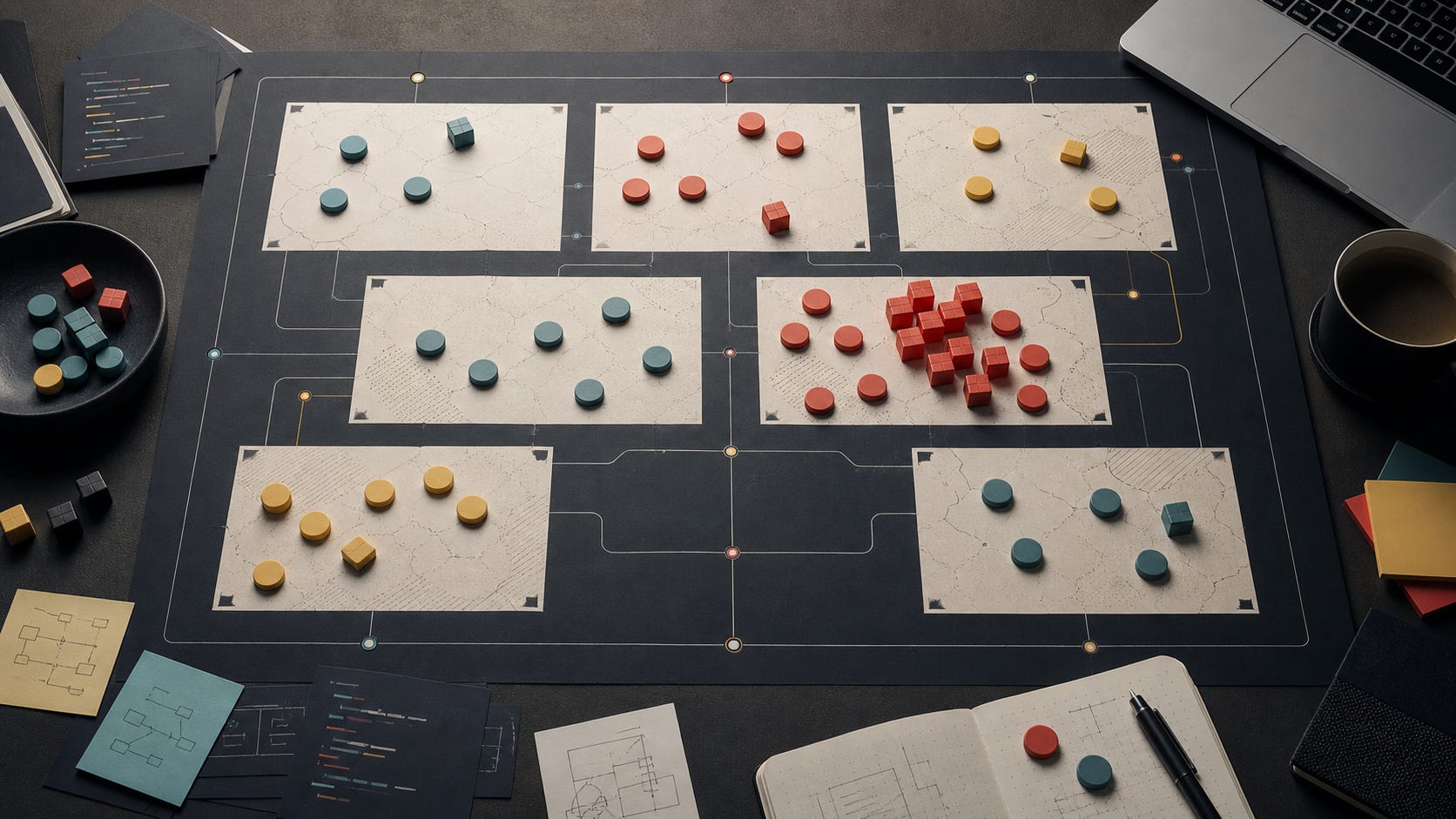
In the Colonel Blotto game, two players allocate limited forces across several battlefields. Each battlefield is won by whoever commits more there, and the overall winner is determined by how those local contests add up. The best strategy is not simply to have more troops, but to concentrate your troops where you can win.
The lesson is that spreading your troops evenly can lose to someone with fewer resources who concentrates them better.
That is starting to sound like software work with AI. You can ask an agent to produce more code but you still have to decide whether that code belongs in the product, whether the problem is worth solving, whether the architecture can absorb it, whether the customer will care, and whether this bet deserves another week of the team’s attention.
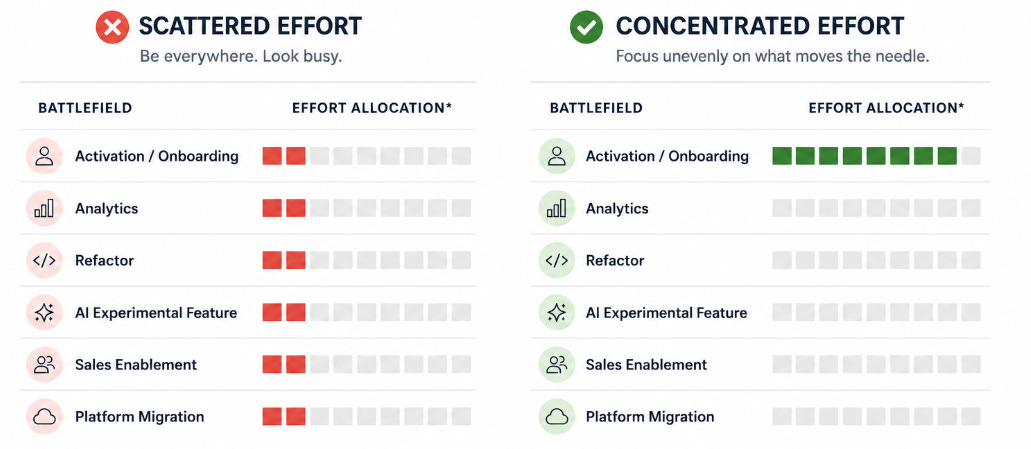
The danger is that cheap execution makes weak allocation feel productive. A team can fill the board with activity: one agent on onboarding, another on analytics, another on a refactor, another on sales enablement, another on an experimental feature. Each effort can look reasonable in isolation. Each can produce visible artifacts. The board looks busy, the demos look encouraging, and the repository evolves.
Then, a month later, nothing important has moved.
Colonel Blotto helps because it treats strategy as a problem of uneven commitment. You do not win by being everywhere. You win by understanding which battlefields matter, which ones can be conceded, and where a little more effort changes the outcome. In product work, that might mean concentrating AI-assisted development on the one workflow that blocks activation instead of generating improvements across ten surfaces. It might mean using agents to explore a narrow technical migration deeply enough to de-risk it, rather than scattering prototypes across every idea in the backlog.
Colonel Blotto frames strategy as asymmetrical. You win by understanding which battlefields matter, which ones can be conceded, and where a little more effort changes the outcome.
There is a second-order implication here that is easy to miss: AI does not just make execution cheaper, it makes plausible work cheaper. That, to me, sounds more dangerous. Bad ideas used to reveal themselves partly through friction. If something was not worth a designer’s week or an engineer’s sprint, it often died before consuming too much organizational attention. That filter was crude and sometimes harmful, but it was a filter.
When AI lowers the cost of first drafts, prototypes, scaffolding, and variations, more ideas survive long enough to look real. The organization then needs a better allocation discipline, because the old friction is gone. Someone has to ask: if this works, what changes? If it does not work, what will we learn? What are we willing to stop doing so this can matter?
The competing interpretation is fair: maybe cheaper execution means teams should try more things. In many cases, they should. AI can make exploration less precious. It can reduce the penalty for sketching alternatives, testing a throwaway implementation, or comparing product directions before committing. That is a genuine advantage.
The mistake is treating exploration capacity as strategy. More options are useful only if the team has a way to choose among them. Otherwise, AI becomes a machine for manufacturing unfinished bets. The team gets wider without getting sharper.
A practical test is simple: ask where additional effort would change the outcome. If a feature is already good enough and the remaining work is polish no one will notice, adding AI-generated variations may not matter. If a workflow is the main reason users fail to activate, concentrated effort there might change the trajectory of the product. If a technical migration blocks every future bet, using agents to reduce uncertainty there may be more strategic than producing another visible feature.
The Blotto question is uncomfortable because it forces loss into the conversation. Where are we choosing not to compete right now? Which reasonable ideas are we letting go? Which battlefield only matters because it is loud, recent, or easy for AI to produce work around? Strategy gets real when the team can name the places it is under-allocating on purpose.
For leaders, this changes the way AI adoption should be judged. The question is not “Are people using agents?” or “Did output increase?” Those are factory questions. The better questions are: Did we concentrate effort on the few constraints that mattered? Did AI help us learn faster where uncertainty was highest? Did we stop more low-value work because production got cheaper? Did the team become better at choosing?
For practitioners, the lesson is more immediate. Before spinning up another agent or generating another path, name the battlefield. What are you trying to win? What would count as winning locally? What would you stop doing if this deserved real concentration? If the answer is vague, the tool may only help you move faster into fog.
AI is an execution advantage, but execution advantage without allocation discipline can become strategic noise. Colonel Blotto gives us a better metaphor because it keeps scarcity in the picture. The scarce thing is no longer just hands on keyboards. It is attention applied unevenly, deliberately, and with enough courage to leave some parts of the board alone.