


The comfortable story
For a long time, product management had a clean shape.
You learn the craft, you earn trust, and you move “up.” Up usually means more scope, more stakeholders, and more distance from the work. That distance is framed as leadership. It’s also framed as leverage.
And it worked, because coordination used to be expensive. If you didn’t have someone translating between design, engineering, analytics, marketing, support, and leadership, the system slowed down.
PRDs mattered because the cost of misunderstanding was high. Status updates mattered because nobody had a shared view of reality. “Keeping things moving” was a real job.
AI doesn’t change why product exists. We still win or lose based on whether we build something that creates value for customers and the business.
But AI does change what it costs to coordinate. And cost changes job shapes.
The tension: coordination is getting cheaper
A lot of what lived inside the coordination layer is now lighter, sometimes dramatically lighter.
Things like writing first drafts of PRDs, turning messy notes into clear user stories, summarizing meetings, extracting action items, translating a vague ask into a structured plan, even basic progress reporting.
With AI, none of that disappears but the effort drops. And when the effort drops, organizations stop rewarding the role that existed mainly to carry that effort.
This isn’t new in principle. We’ve always known that more options and faster feedback lead to better decisions. What’s changed is how cheap those options are to generate.
That’s why the PM role doesn’t just feel like it’s “evolving.” It feels like it’s splitting. Like the bar is moving as Charmy Jilka called out. That’s all because the underlying economics of the work are shifting.
The split: builders and coordinators
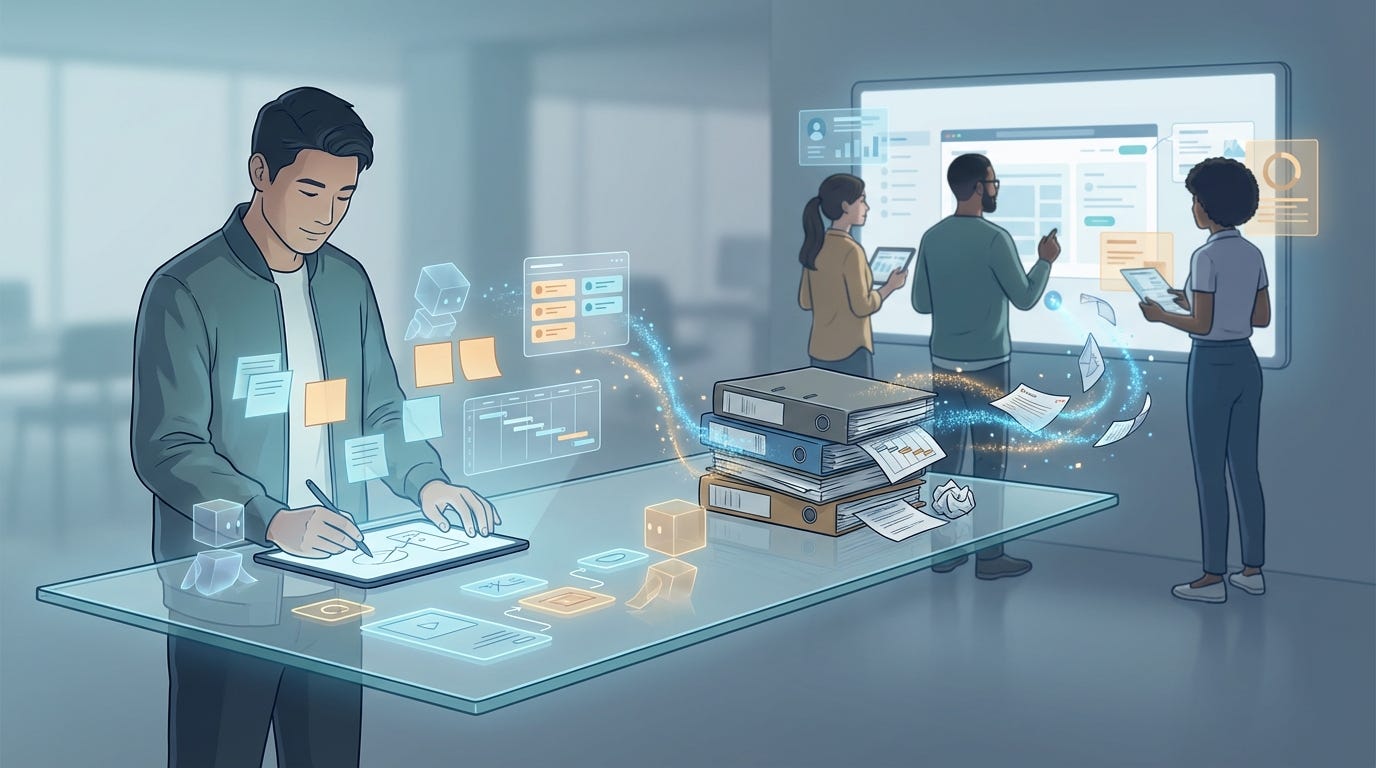
On one side are builders. These are not “engineers who moonlight as PMs.” These are builders in the product sense: People who take an idea and put pressure on it, explore multiple paths, test assumptions early, and get something real in front of users.
AI amplifies this type. Not through sheer speed, but through widening the surface area they can explore before committing. These Builders can consider more prototypes, more scenarios, more edge cases, more learning per unit time.
On the other side are coordinators. This is role many of us grew up with (or grew into). Coordinators align stakeholders, manage process, translate between functions, keep work moving.
In the world of AI, this is still valuable. Every organization needs people who can connect dots across teams.
But the “manual labor” inside coordination is shrinking, and that changes the bargain. If the coordination layer can be partially automated, then coordination alone stops being the value.
The uncomfortable part: careers were built on the old bargain
Here’s where it gets personal. A lot of product people build their careers by getting better at that coordination layer. They earn credibility by being the person who can bring clarity to chaos. Being a good leader has always looked like adding more of that.
Even further, most product organizations are still structured around coordination processes to keep things moving like status updates and alignment layers.
But what if abstraction isn’t the scarce resource anymore? What if closeness to reality is? That’s a disorienting shift, not because the work changed, but because what’s valuable did.
AI doesn’t remove the need for ownership, incentives, and decision-making. As Matt Haney put it: it can automate reporting, but it won’t fix a broken KPI cadence or unclear ownership. In other words: AI can reduce coordination work, but it doesn’t replace accountable operating models.
So the people who were rewarded for carrying the coordination layer now have to ask a harder question:
What is my value when coordination is no longer the bottleneck?
The system reframe: leverage comes from reducing coordination, not managing it
This is not an argument for builders vs collaborators. Not everyone needs to learn to code, but more people need to learn how to build.
That might look like: turning an idea into something tangible (a prototype, a flow, a draft), generating multiple approaches instead of debating one, or designing how something will be evaluated before it ships.
The real divide is between people who help the system learn and people who help the system talk to itself.
Leaders with the most leverage right now don’t look like they’re adding coordination. They look like they’re removing it. They still operate at the system level setting direction, articulating trade-offs, and shaping incentives. But the new class of leaders in the AI age are also close enough to the work to engage without disrupting the flow. They can test assumptions without spinning up a full process. They can validate a direction without turning it into a six-week alignment tour. It’s not that the role is splitting, the bar is moving.
Coordination isn’t going anywhere, it just doesn’t carry you anymore. AI is eating the “keep things moving” work.
A few months ago, a team would’ve spent days or weeks aligning on a one-pager doc before building anything. A lot of effort went into just getting something everyone could react to. Quite often that reaction was a realization we didn’t know enough, which tacked on more time.
Now we generate multiple directions in an hour and react to something real. There are still information gaps, but they show up faster and earlier, when they’re cheaper to address.
What’s left is whether you can think clearly, test fast, and actually build something that matters.
A useful question: who owns the outcome?
If builders ship fast but don’t connect to the business need, you get impressive demos that go nowhere.
If coordinators keep everyone informed but don’t produce customer value, you get motion without progress.
So again the question isn’t “builder or coordinator” as an identity. It’s: who owns the outcome, and how do they learn their way into it?
In many orgs, that question is left implicit. Everyone assumes the system will produce the outcome. But systems don’t produce outcomes. People do: Through decisions, trade-offs. through what they choose to measure and ignore.
AI makes this more obvious because it removes some of the scaffolding. When the paperwork gets cheaper, the thinking becomes the work.
What this means for PMs (and for teams)
If you’re a PM, the implication is straightforward and uncomfortable. If your main value is translating and coordinating, you’re sitting on a shrinking island. You can still be useful, but you won’t be differentiated.
Your leverage is moving toward:
Clear thinking under uncertainty
Fast, low-cost validation
Product judgment that shows up in decisions, not documents
The ability to build “just enough” artifact to learn, not to perform
Operating model design: ownership, metrics, cadence, incentives
And if you’re a product leader, there’s a second implication: Leadership may no longer mean more distance from the work.
It may mean being close enough to reality to remove friction, not add it. To be close enough to ask better questions and to see the system fail before the quarterly business review.
The bet
Being a builder isn’t about tools. It’s about lowering the cost of exploring options so decisions improve
The PM role isn’t going away, but I don’t think we can assume that the prestige path continues to be “more abstraction, more coordination.”
In the version that survives, leaders will look a lot more like builders. NOt for the reason that coordination stops mattering but because the organization can finally afford to make coordination less central.
And when you can afford that, you find out what was always true:
The work was never the paperwork.
The work was the judgment.