AI agent decisioning: what to delegate and what to decide (the Thanksgiving test)
How AI agents can take on the work without taking over the decisions.

Most years, my wife and I host Thanksgiving. A smorgasbord of gluttony takes some planning, and I’ve been wondering how much an AI agent could take on. Given a guest list and budget, could it work out the ingredients and quantities, build a cart, and arrange delivery? And, of course, would it choose a good turkey?
I’d happily delegate plenty of that. But there are decisions we make that an agent might not know to ask about. Would it check for food allergies if I forgot to mention them? Would it assume we wanted last year’s recipes? I wouldn’t want it buying nuts for the stuffing without checking, even if everything fit the budget. I’d judge a product like this by how much easier it made planning our meal, including the choices we wanted to keep.
Giving Gobble enough information to plan
Let’s give this a shot. I put together a simulation with an agent I named Gobble. I let it find and choose ingredients and quantities within my constraints, while keeping the decision to buy. It generated local planning views; it didn’t add products to a live H-E-B cart or place an order.
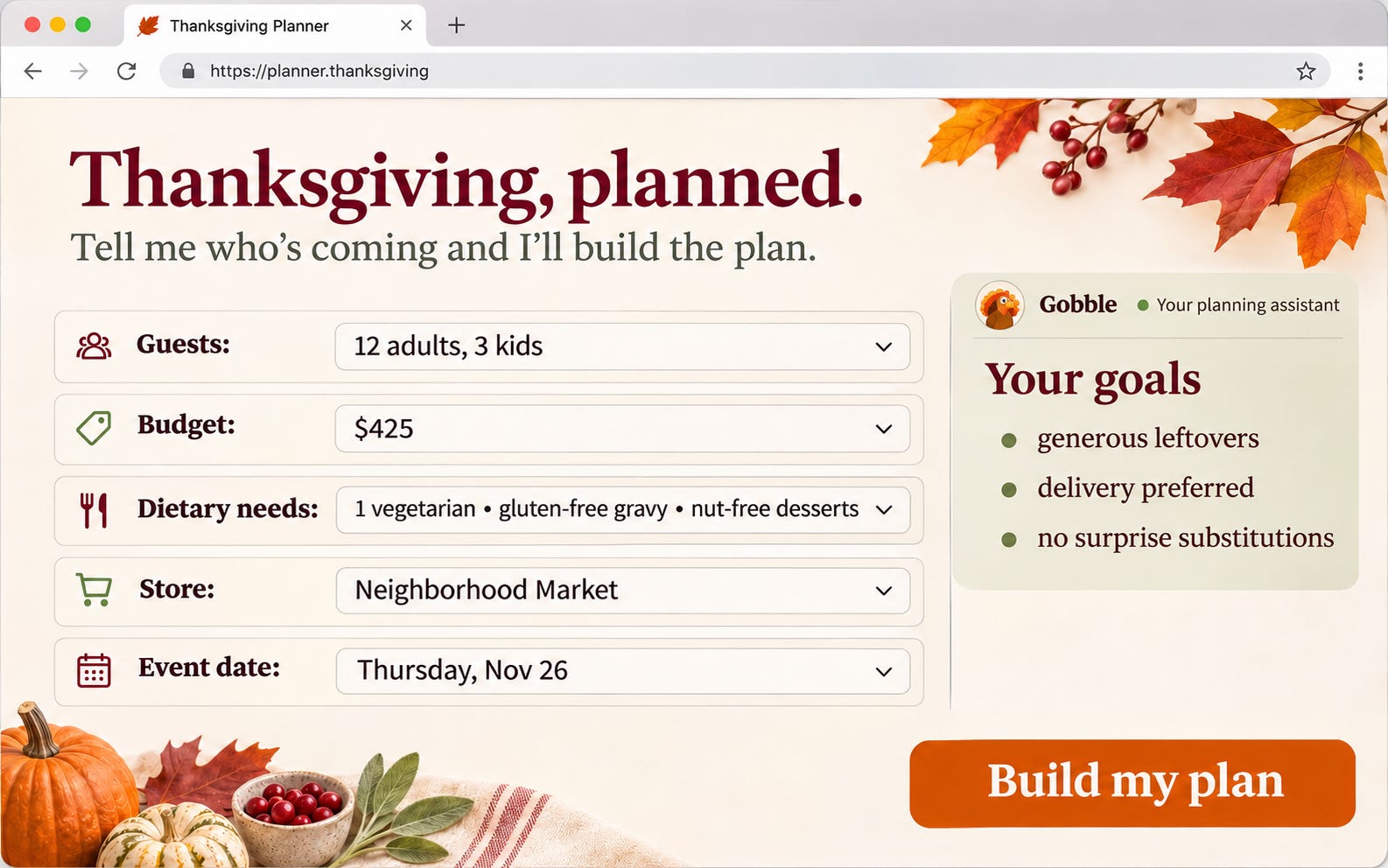
Gobble created a neat little webpage for me to enter details, including a field for dietary restrictions I hadn’t asked it to include. The page felt like overkill, but I went with it. Asking about restrictions gave it information that could change which dishes and ingredients belonged in the plan.
Then Gobble produced a multi-page list of ingredients, budget allocation, and dietary constraints. At first, I felt frustrated. I thought I was being asked to approve every ingredient and quantity. I’d asked for help planning the meal, and this looked like a lot of decisions being handed back to me.
The list mixed calculations with food-handling instructions and unfinished checks. For the gravy, it specified broth and butter quantities alongside a reminder to check that every packaged ingredient was gluten-free. Elsewhere, it called for a separate tray for the vegetarian dish. Reading it was overwhelming, and it’s not how I would typically organize things myself.
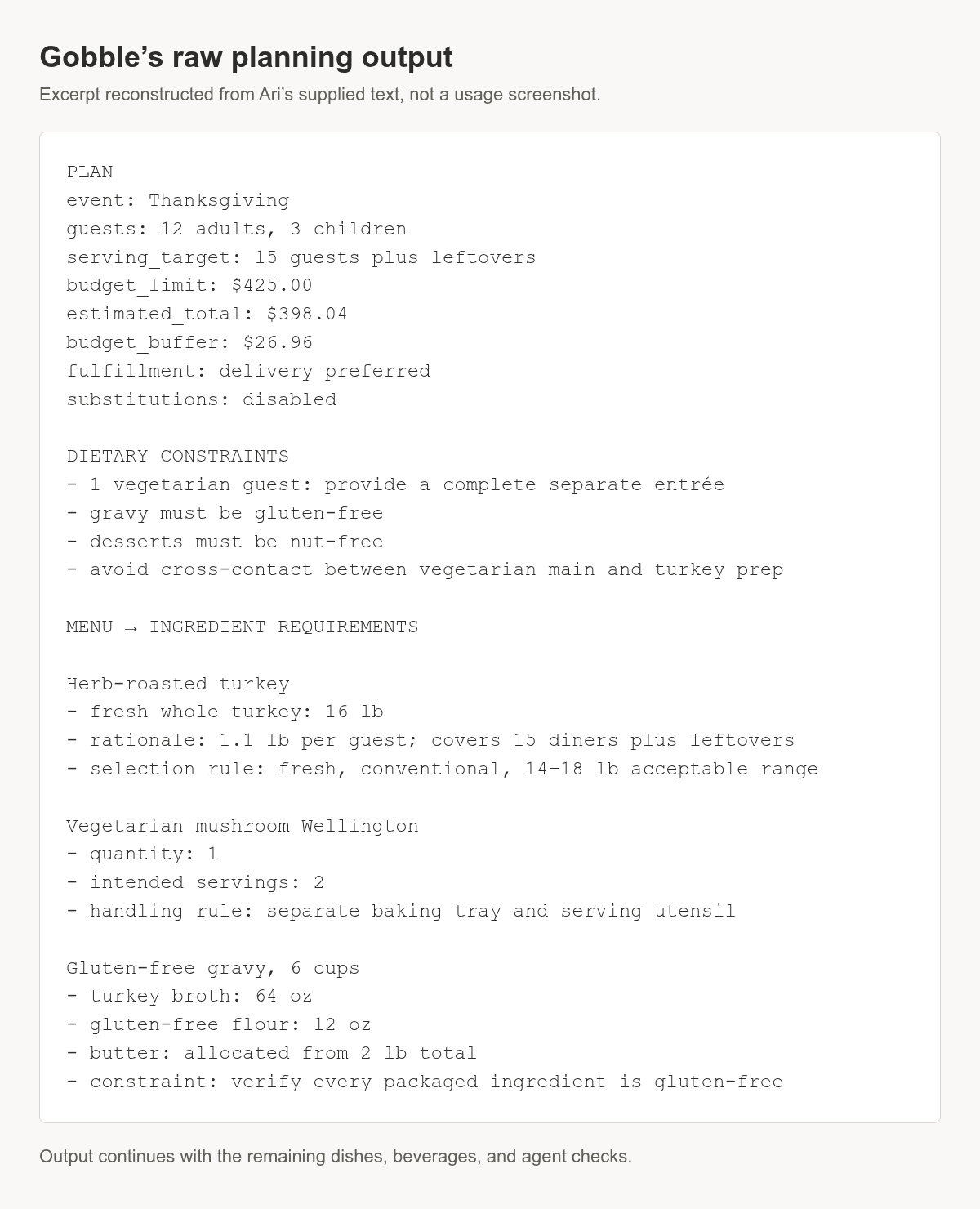
I had to work out which entries described choices Gobble had made and which required something from me. Gobble had generated plenty, but I was still sorting out what I was supposed to do next. If a product made me turn that output into a usable plan myself, generating the list would only finish part of the work I’d come for.
Reviewing the meal without approving every ingredient
But then Gobble showed me the planning view, and I felt relieved. I could see what the list looked like as a meal. I found myself thinking, of course, AI doesn’t think like humans do. The menu, quantities, and estimated cost were together. I could react to the meal without assembling it in my head from the ingredients.
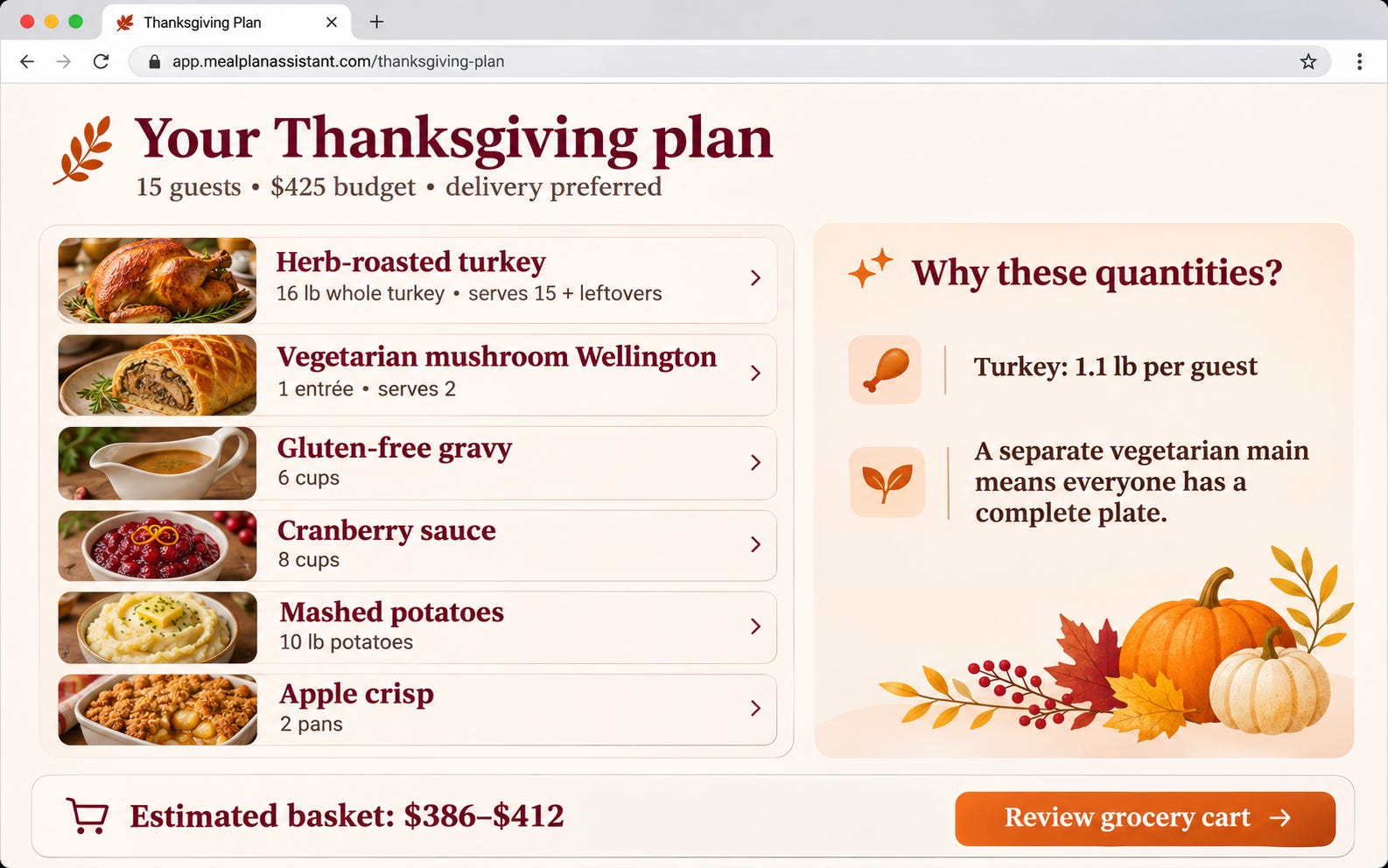
If I’d been using this as a product, the first list could have been enough to make me stop. I was glad I’d gone along with the webpage that initially felt excessive.
Take walnuts in stuffing. One or two guests love walnut stuffing, one or two hate it, and the rest are indifferent. This year we are opting out. I don’t want to calculate how much stuffing we need, but I do want to be asked before Gobble changes the recipe. In a long ingredient list, walnuts could look like just another item whose quantity it had calculated.
A menu makes that choice easier to discuss if it tells me which stuffing Gobble proposes. A generic “stuffing” label could hide the same change as the ingredient list. Product builders have to decide what someone needs to see to make the next decision. For me, that includes the recipe choice; it doesn’t require approving Gobble’s calculation of how much stuffing to make.
In An AI SDLC for XP Practitioners, I describe rendering agents’ Markdown plans as HTML so people can review them more easily. The plan and acceptance criteria give us a chance to question intended behavior before implementation. Gobble’s menu offered a similar opportunity: review the proposed meal before proceeding to groceries. Neither view can help us question a choice it leaves out.
What still needed checking in the cart
As a final check, Gobble compared its plan with my details. It reported “dietary requirements mapped to individual dishes: pass,” but farther down said “gluten-free gravy ingredients: verify at cart review.” I took that as a decent reminder to check the packaged ingredients myself.
In Goodhart’s Law and the limits of agent instructions, I asked what an agent would treat as proof it succeeded. Here, I was looking at what I might mistake for proof the job was done. Planning gluten-free gravy didn’t establish that the ingredients were suitable. Showing only the “pass” could hide that difference, so the pending check needed to stay visible where I would review the actual products.
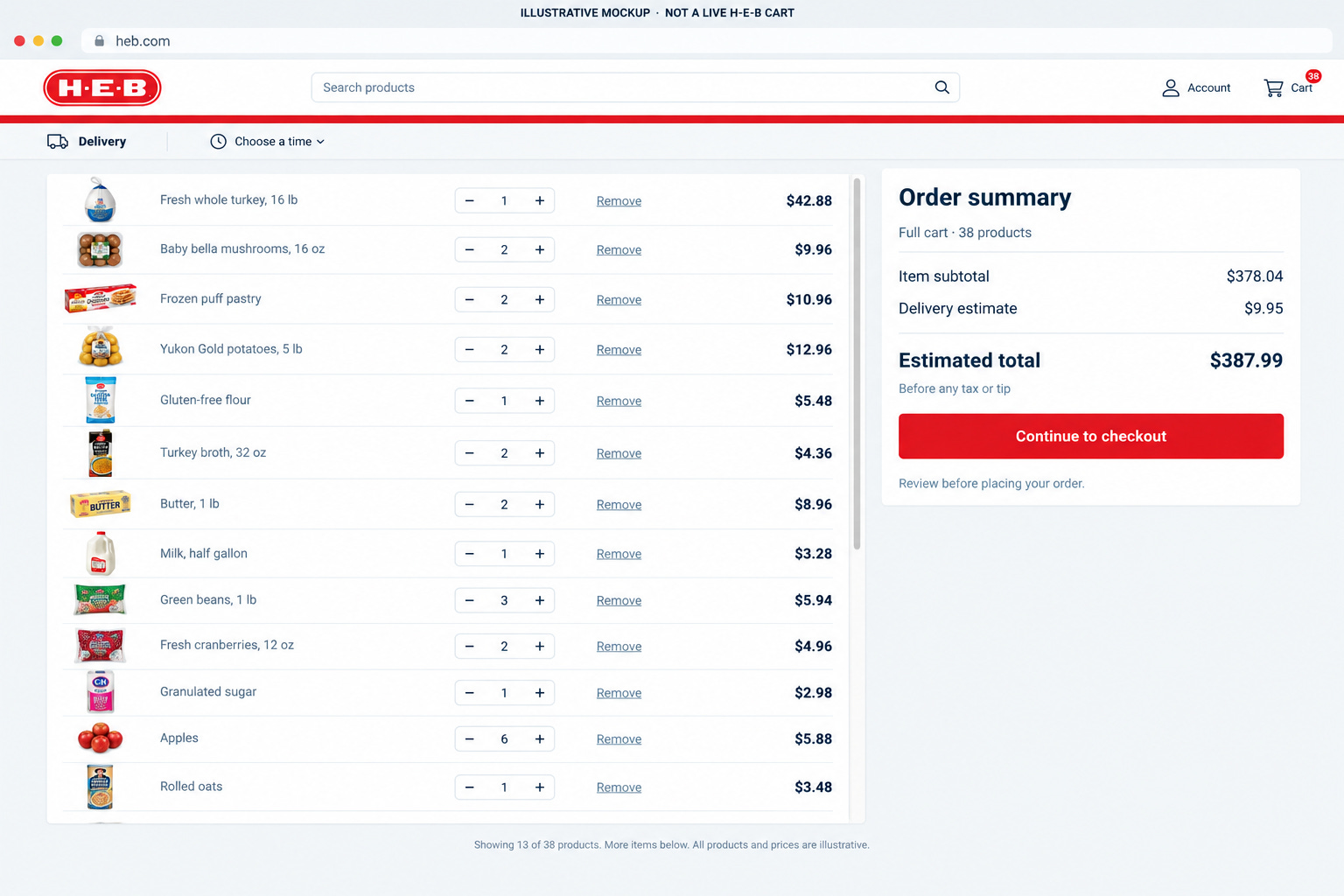
The simulated cart showed groceries organized in one place, as I’d wanted. It was still an illustrative mockup, not a live H-E-B cart. A working version would need to add actual products to my grocery account.
What does purchase approval actually approve?
Gobble wrapped up with a final confirmation screen. Asking for approval made sense since preparing a cart wasn’t permission to buy it. What confused me was how ready everything looked, including a delivery window shown as available. This was a simulation, so that window wasn’t verified availability.
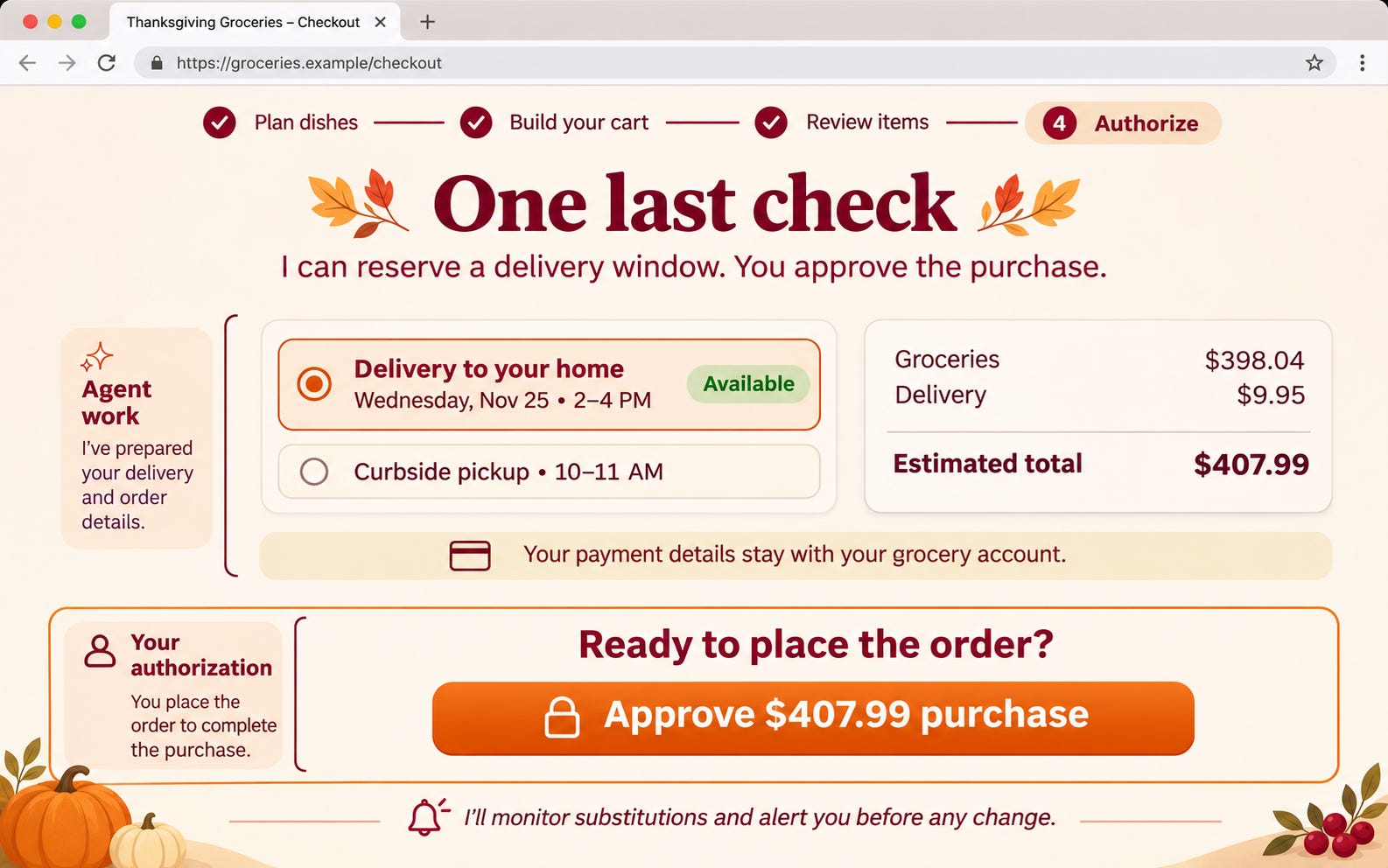
By this point, approving the purchase would appear to be the only decision left. Yet I still need to know whether the ingredients had been checked and whether delivery was actually available. My willingness to spend the money wouldn’t answer either question. I’d need those answers to understand what I was approving.
In a working product, the software would also need to prevent an order until I explicitly approved it. A prompt or approval button alone wouldn’t enforce that restriction, and this simulation didn’t test it. If I don’t answer, Gobble should wait.
Building an agent around the meal-planning task
A saved grocery list might still be easier for a meal we make every year. This simulation doesn’t tell me whether Gobble would save time overall. The relief of seeing the meal was real, but I’d still have work to do before ordering. A product using an agent has to improve that whole experience, including the review and corrections, to be worth choosing over the list.
As product builders, we need to decide what agents can do alongside how people will review their decisions and unfinished work. I want Gobble to calculate quantities without asking me to repeat the calculations, and bring a recipe change back to me before treating it as agreed. I should be able to change that choice without rebuilding the plan. With unfinished checks visible and purchase approval enforced, I could use its work without redoing the planning or overlooking what still needed checking.
Discussion about this post